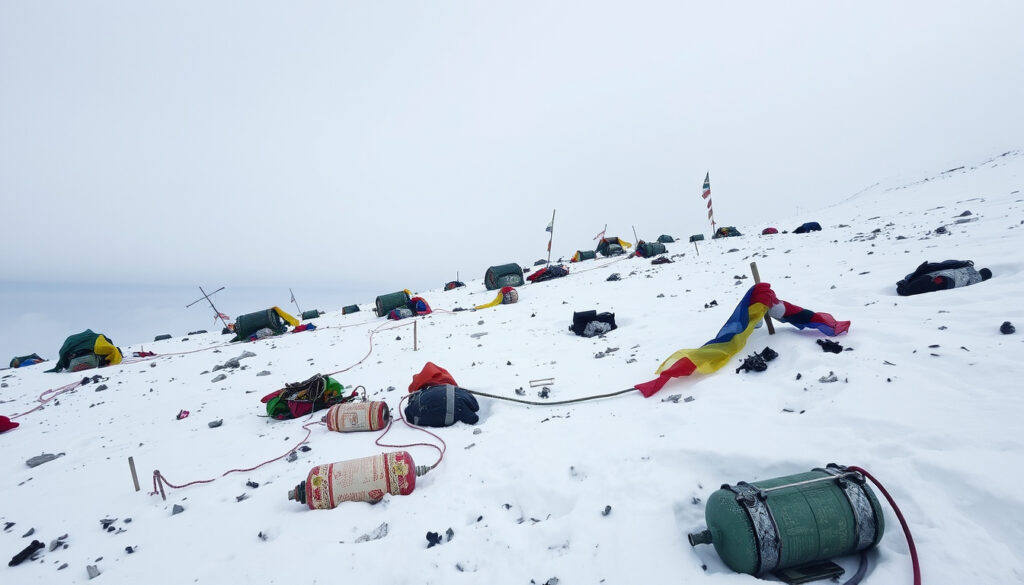
Bodies on Everest: Why 200+ Corpses Remain on the Mountain
Few things capture the imagination like the frozen remains of climbers who never came home from Mount Everest. Over 200 bodies still lie on the mountain, according to BBC News (UK broadcaster), preserved by freezing temperatures and thin air. This guide connects the science, the ethics, and the logistics behind why recovery is so rare, and what the future holds for those who remain.
Estimated bodies remaining on Everest: more than 200 ·
Oldest body still on the mountain: George Mallory (1924) ·
Most famous corpse: Green Boots (1996) ·
Fatalities per year (average): 2–3 ·
Total deaths since 1922: over 346
Quick snapshot
- Over 200 bodies remain on Everest (All That’s Interesting (specialist outlet))
- George Mallory’s body was found in 1999 (All That’s Interesting)
- Green Boots is identified as Tsewang Paljor, who died in 1996 (All That’s Interesting)
- Exact location of many bodies due to shifting glaciers (Mark Horrell (Everest guide))
- Whether Green Boots is still visible on the Northeast Ridge as of 2025 (Mark Horrell (Everest guide))
- Total number of bodies is an estimate, not a precise count (BBC News)
- 1924: George Mallory and Andrew Irvine disappear near summit (BBC News)
- 1996: Green Boots (Tsewang Paljor) dies; Rob Hall dies in storm (BBC News)
- 2024: Nepal recovers four frozen bodies in a cleanup operation (BBC News)
- Nepal has signaled intention to continue cleanup operations (Namas Adventure (mountaineering guide))
- Melting glaciers may expose more bodies in coming years (Namas Adventure (mountaineering guide))
- Improved recovery technology could make retrieval safer but remains cost-prohibitive (Namas Adventure (mountaineering guide))
Five key facts about Everest’s dead, one pattern: the extreme altitude makes every statistic a story of impossible conditions.
The numbers below frame Everest’s deadly arithmetic.
| Fact | Value |
|---|---|
| Total estimated bodies on Everest | 200+ |
| Highest number of deaths in a single year | 2023 (18 deaths) |
| Most common cause of death | Avalanche, fall, altitude sickness |
| Altitude of the death zone | Above 8,000 meters |
| Water boiling point at summit | 71°C |
Bottom line: The data reveals a mountain that takes more than it gives, and leaves the evidence visible for decades.
What happens to bodies left on Everest?
Why bodies are not removed
- Recovery is extremely dangerous in the death zone. All That’s Interesting (specialist outlet) notes that the risk of death for rescuers is high.
- Cost is prohibitive: between $60,000 and $80,000 per body, according to Himalayan Recreation (Everest logistics company).
- Helicopters cannot operate at the highest altitudes, and the Chinese government bans helicopter use on the north side (Mark Horrell).
Even when families request recovery, the mountain often denies permission: no rescue team can guarantee survival above 8,000 meters.
How altitude and weather preserve corpses
Below-freezing temperatures and low oxygen mummify bodies rather than decompose them. All That’s Interesting (specialist outlet) explains that remains can look almost the same decades later — skin leathery, clothes intact. The BBC reported in 2024 that four recovered climbers were so frozen their limbs could not be moved when found (BBC News).
The death zone: above 8,000 meters
The death zone is defined as altitudes above 8,000 meters where the body cannot acclimatize. Namas Adventure (mountaineering guide) states that human survival in this zone is limited to roughly 16 to 20 hours. Most deaths and body abandonments occur here.
Where is Rob’s body on Everest today?
Rob Hall’s death cause and last words
Rob Hall, a New Zealand guide, died on the South Col during the 1996 Everest disaster. His body remained near the summit for years. According to survivors, his last radio call to base camp said, “I am going to die here.” As of 2025, his exact location is believed to be still on the mountain, though shifting snow may have moved or covered it.
“I am going to die here.”
— Rob Hall’s last words (via expedition survivors)
Rob Hall’s body is a symbol of the 1996 tragedy that killed eight climbers. His presence on the mountain continues to shape safety protocols.
What is the most famous corpse on Everest?
The story of Green Boots
Green Boots is the corpse of Tsewang Paljor, an Indian climber who died in 1996. For two decades his body, identifiable by green boots, lay in a cave on the Northeast Ridge and became a landmark for climbers. All That’s Interesting (specialist outlet) reports that in 2014, the body was moved or covered by climbers to reduce the macabre sight.
“Green Boots became a well-known landmark on the Northeast Ridge.”
— Wikipedia (encyclopedic source)
Other notable bodies: Sleeping Beauty, Hannelore Schmatz
Francys Arsentiev (“Sleeping Beauty”) died in 1998 and was visible for years before being moved. Hannelore Schmatz, a German climber, died in 1979 and remained seated against a rock until recovery efforts later covered her. Each body tells a story of the era’s climbing culture and equipment limits.
Bottom line: Each named corpse on Everest marks a moment in climbing history that the mountain refuses to bury.
What is the oldest body still on Everest?
George Mallory and Andrew Irvine (1924)
George Mallory and Andrew Irvine disappeared near the summit in 1924. Mallory’s body was discovered in 1999 by the Mallory and Irvine Research Expedition, well preserved at 8,200 meters. Irvine’s body has never been found. Their remains are the oldest known on the mountain, and the mystery of whether they reached the summit before dying remains unresolved.
Mallory’s body, found 75 years after his death, looked almost as it did in 1924. The mountain’s freezing air had mummified him, leaving his clothes intact and his famous question unanswered.
Why can’t you climb Mount Everest after 2pm?
The 2 PM rule explained
The 2 PM turnaround time is a safety rule enforced by expedition leaders. Namas Adventure (mountaineering guide) explains that afternoon weather on Everest deteriorates rapidly, with high winds and storms. Descending in darkness without oxygen is fatal.
Weather and safety risks
Climbers who ignore the 2 PM rule often become the next body on the mountain. The rule is not law but a guideline based on decades of fatal experience.
Why can’t you boil an egg at the top of Mount Everest?
The science of boiling point at altitude
At the summit of Everest, atmospheric pressure is about one-third of sea level. Water boils at 71°C (160°F), far below the 100°C needed to cook an egg’s proteins. Namas Adventure (mountaineering guide) confirms that the relationship between vapor pressure and boiling point makes cooking impossible at that altitude.
Timeline: Key events in Everest’s body history
Every event adds a chapter to Everest’s grim archive, with 2024 marking the first coordinated government effort to bring bodies down.
- — George Mallory and Andrew Irvine disappear near summit.
- — Green Boots (Tsewang Paljor) dies; Rob Hall dies in storm.
- — Mallory’s body discovered by Mallory and Irvine Research Expedition.
- — Green Boots moved or covered by climbers.
- — BBC reports retrieval of four frozen bodies in a 54-day Nepal cleanup operation.
What we know vs. what remains unclear
Confirmed facts
- Green Boots is Tsewang Paljor, died in 1996 (All That’s Interesting (specialist outlet))
- Rob Hall’s body was located near the South Col (Mark Horrell)
- Mallory’s body was found in 1999
- Water boils at 71°C on the Everest summit
What remains unclear
- Exact current location of many bodies due to shifting glaciers (Mark Horrell)
- Whether Green Boots is still visible on the Northeast Ridge as of 2025
- Total number of bodies is an estimate, not a precise count (BBC News)
- Irvine’s body remains missing (All That’s Interesting)
Confirmed facts come from expeditions and press reports; uncertainty grows the higher you go. For researchers, the gap between what we know and what we don’t is Everest’s most enduring mystery.
Perspectives from the mountain
“The bodies were so frozen that limbs could not be moved.”
— BBC News (2024 cleanup report)
“Green Boots became a well-known landmark on the Northeast Ridge.”
— Wikipedia (encyclopedic source)
“Most bodies are hidden from view on the North Face, Kangshung Face, or in crevasses in the Khumbu Icefall.”
— Mark Horrell (Everest guide)
Related reading
- Dead Bodies on Mount Everest — Himalayan Recreation
- Mount Everest Rainbow Valley — Himalayan Recreation
reddit.com, ecoholidaysnepal.com, ecoholidaysnepal.com, climbingthesevensummits.com, swotahtravel.com, facebook.com
Frequently asked questions
Why are bodies left on Everest instead of being removed?
Because recovery in the death zone is extremely dangerous, slow, and expensive. The cost can exceed $70,000 per body, and helicopters cannot operate at high altitudes.
How many dead bodies are on Mount Everest?
Estimates range from 200 to over 300, with more added each year. Exact counts are impossible due to shifting glaciers and unrecovered bodies.
Is Green Boots still on Everest?
As of the last reports, Green Boots was moved or covered in 2014. Its current visibility is uncertain.
What was Rob Hall’s cause of death?
Rob Hall died of exposure and altitude sickness during the 1996 Everest disaster after being caught in a severe storm at the South Col.
Can you boil water on Mount Everest?
Yes, water boils at 71°C on the summit, but that temperature is too low to cook an egg or kill most bacteria adequately.
What is the 2 PM rule on Everest?
A safety rule that climbers must turn around by 2 PM to avoid afternoon storms and deadly descents in darkness.
Who was the first person to die on Everest?
The first recorded death was in 1922 when seven Sherpas died in an avalanche. The earliest Western death was George Mallory in 1924.
For future climbers, the choice is clear: respect the mountain’s dead, or risk becoming part of its frozen archive. Every expedition that ignores the 2 PM rule or pushes beyond its limits adds another body to Everest’s tally — and another story to the mountain’s eternal silence.
More related posts
 Legia Warszawa vs Chelsea – Match Report and Key Insights
 ASAP Rocky Acquitted: Gun Assault Trial, Biography & Family
 Justin Carbonneau: Stats, Background, Football Mentality
 Sol Ruca: Real Name, Age, Partner, Relationship Status & Career
 Tom Felton: Sobriety, Collapse, and Friendships
 Michael Caine Arm Loss & Wheelchair Myths Debunked
