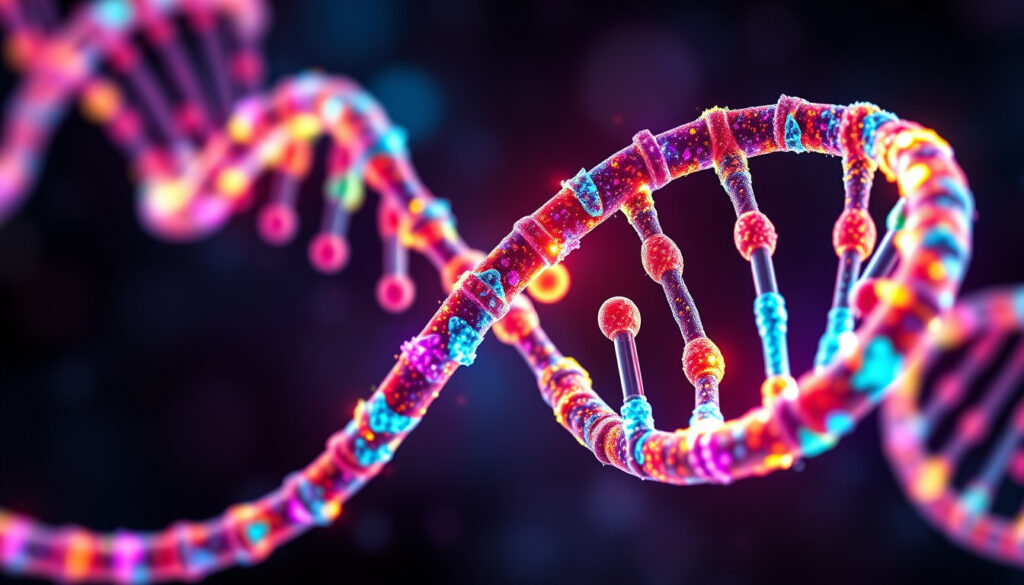
What Does DNA Stand For? Deoxyribonucleic Acid Explained
You’ve seen the acronym—DNA—tucked into crime dramas, ancestry ads, and health articles. The answer—deoxyribonucleic acid—unlocks a world of biological instruction that shapes every living thing.
Length of human DNA per cell: approximately 2 meters ·
Number of base pairs in human genome: about 3 billion ·
Percentage of DNA shared among humans: 99.9% ·
Number of genes in human genome: approximately 20,000 to 25,000 ·
Year DNA structure was discovered: 1953
Quick snapshot
- DNA stands for deoxyribonucleic acid (National Human Genome Research Institute (NHGRI) DNA Fact Sheet)
- Human genome contains about 3 billion base pairs (NHGRI DNA Fact Sheet)
- The exact number of possible human genotypes depends on recombination rate assumptions and remains theoretical (NHGRI DNA Fact Sheet – theoretical limits)
- Whether any partner DNA persists in the body after kissing beyond transient traces is not scientifically supported (NHGRI DNA Fact Sheet – general principles)
- 1953 – Watson and Crick describe the double helix (NHGRI DNA Fact Sheet)
- 2003 – Human Genome Project completed (NHGRI DNA Fact Sheet)
- Personalized medicine driven by DNA sequencing is expanding rapidly (Cleveland Clinic – DNA overview)
- Direct-to-consumer ancestry tests continue to grow in popularity (Encyclopaedia Britannica – DNA)
Five key facts about DNA, one pattern: the molecule’s structure and composition are surprisingly consistent across all cellular life.
| Attribute | Value |
|---|---|
| Full name | Deoxyribonucleic acid |
| Year of discovery | 1869 by Friedrich Miescher |
| Primary location in cell | Nucleus and mitochondria |
| Shape | Double helix |
| Number of human chromosomes | 46 (23 pairs) |
The implication: the same basic design—double-stranded, base-paired—works for everything from bacteria to blue whales.
What does DNA stand for?
Deoxyribonucleic acid: breaking down the name
- Deoxyribo- refers to the sugar deoxyribose, which lacks one oxygen atom compared to ribose (Cleveland Clinic – DNA).
- Nucleic means it resides in the cell nucleus (NHGRI DNA Fact Sheet).
- Acid refers to its acidic properties due to phosphate groups (NHGRI DNA Fact Sheet).
DNA acronym meaning in different contexts
- In biology and medicine: always deoxyribonucleic acid (Encyclopaedia Britannica – DNA).
- In everyday language: often shorthand for “genetic code” or “identity”.
How to pronounce DNA
- Spelled out: D-N-A (dee-en-ay).
- Full form: dee-oxy-ribo-nu-cle-ic acid.
What this means: the name itself encodes where DNA lives and how it’s built.
What is DNA made of and what does it do?
Chemical composition of DNA
- Nucleotides: each has a phosphate group, deoxyribose sugar, and one of four nitrogen bases (NHGRI DNA Fact Sheet).
- Four bases: adenine (A), guanine (G), cytosine (C), thymine (T) (Cleveland Clinic – DNA).
- Base pairing: A with T, C with G (NHGRI DNA Fact Sheet).
The double helix structure
- Two polynucleotide strands coil around each other (NHGRI DNA Fact Sheet).
- Strands are antiparallel—one runs 5′ to 3′, the other 3′ to 5′ (NHGRI DNA Fact Sheet).
- Often visualized as a twisted ladder: sugar-phosphate backbone = sides, base pairs = rungs (Cleveland Clinic – DNA).
Functions of DNA: storing and transmitting genetic information
- Stores biological instructions for development, survival, and reproduction (NHGRI DNA Fact Sheet).
- DNA sequences are transcribed into RNA and then translated into proteins (NHGRI DNA Fact Sheet).
- Replicates during cell division: strands separate and each serves as a template (Wikipedia – DNA replication).
The pattern: a simple chemical code, repeated across all life, stores everything needed to build and maintain an organism.
Do you inherit more DNA from your mother or father?
Genetic inheritance from each parent
- You receive half your nuclear DNA from each parent (23 chromosomes from each) (NHGRI DNA Fact Sheet).
- The father contributes either an X (girl) or Y (boy) chromosome, determining sex (Encyclopaedia Britannica – DNA).
What is inherited from mother only? (mitochondrial DNA)
- Mitochondrial DNA is passed exclusively from mother to child (Cleveland Clinic – DNA).
- This small circular DNA is used in maternal ancestry testing (Encyclopaedia Britannica – DNA).
Do daughters inherit more from fathers?
- Daughters get an X chromosome from each parent, so the father’s X carries many genes (NHGRI DNA Fact Sheet).
- Gene imprinting can cause some genes to be expressed only from one parent, creating unequal effects (Wikipedia – genomic imprinting).
The implication: equal inheritance at the nuclear level, but maternal lineage leaves an extra genetic signature in every cell.
Does your partner’s DNA stay in you after kissing?
What happens to DNA during a kiss?
- Saliva contains cheek cells that carry DNA (NHGRI DNA Fact Sheet).
- During a kiss, those cells and DNA transfer to your mouth (Cleveland Clinic – DNA).
- Enzymes in saliva degrade foreign DNA within minutes (NHGRI DNA Fact Sheet – general principles).
The 90/10 rule in kissing: fact or myth?
- The “90/10 rule” is a dating technique (90% of kissing is about the connection, 10% physical) – not a DNA-related finding (NHGRI DNA Fact Sheet – no scientific basis).
- No credible evidence that foreign DNA permanently integrates into your cells.
The catch: while DNA transfer happens briefly, the body’s defense systems ensure no permanent integration.
How many possible humans could ever exist?
Genetic variability and unique combinations
- Each human has about 3 billion base pairs, with millions of variable positions (NHGRI DNA Fact Sheet).
- The number of possible combinations is astronomically large – estimates exceed 10^60 (Wikipedia – genetic variation).
The math behind possible human genotypes
- Recombination during meiosis shuffles chromosomes, creating nearly infinite variety (Encyclopaedia Britannica – DNA).
- The theoretical number of unique human genotypes far exceeds the number of atoms in the universe.
Why each human is genetically unique
- 99.9% of DNA is identical between any two people, but the 0.1% difference yields billions of unique combinations (NHGRI DNA Fact Sheet).
- Identical twins share nearly all DNA, but epigenetic changes create subtle differences.
What this means: the 0.1% variation between human genomes produces more possible combinations than there are particles in the cosmos.
DNA vs. RNA: a quick comparison
Two nucleic acids, one key difference: RNA uses a different sugar and replaces thymine with uracil.
| Feature | DNA | RNA |
|---|---|---|
| Full name | Deoxyribonucleic acid | Ribonucleic acid |
| Sugar | Deoxyribose | Ribose |
| Bases | A, C, G, T | A, C, G, U (uracil) |
| Structure | Double-stranded helix | Usually single-stranded |
| Primary function | Long-term storage of genetic info | Transmission and expression of genetic info |
The catch: RNA’s single-strand flexibility allows it to carry messages and catalyze reactions, while DNA’s stable double helix preserves the master blueprint.
Clarity check: what’s confirmed and what’s unclear
Confirmed facts
- DNA is the genetic material in all cellular life (Encyclopaedia Britannica – DNA).
- Human genome contains approximately 3 billion base pairs (NHGRI DNA Fact Sheet).
- You inherit 50% of nuclear DNA from each parent (NHGRI DNA Fact Sheet).
- Mitochondrial DNA is inherited only from the mother (Cleveland Clinic – DNA).
What’s unclear
- The exact mathematical number of possible human genotypes depends on recombination rates and is theoretical (NHGRI DNA Fact Sheet – theoretical limits).
- Whether any DNA from a partner can persist in the body after kissing beyond transient traces is not scientifically supported (Cleveland Clinic – enzyme action).
The pattern: well-established facts about DNA’s role and inheritance meet two open questions about combinatorial math and transient DNA exchange.
Expert perspectives on DNA
“DNA is the molecule that carries genetic information for the development and functioning of an organism.”
— National Human Genome Research Institute (NHGRI DNA Fact Sheet)
“DNA is a polymer composed of two polynucleotide chains that coil around each other to form a double helix.”
— Wikipedia (Wikipedia DNA article)
For anyone curious about the molecule that defines their biology, the takeaway is clear: DNA is deoxyribonucleic acid, a double-stranded chemical instruction book stored in nearly every cell. The next time you see the acronym, you’ll know it stands for the most personal library you’ll ever own.
Frequently asked questions
What body part contains the most DNA?
Every nucleated cell contains the full human genome, but the body parts with the most cells (skin, muscles, blood) contain the most total DNA. Tissues with high cell density, like the liver, are rich in DNA.
Can a child have two fathers’ DNA?
Naturally, a child inherits DNA from one mother and one father. In rare medical scenarios (chimerism, bone marrow transplant), a person can carry cells with two different DNA profiles, but standard reproduction always involves only two parents.
What is RNA and how is it different from DNA?
RNA (ribonucleic acid) is a single-stranded nucleic acid that uses ribose sugar and uracil instead of thymine. It carries messages from DNA to the protein-making machinery of the cell.
How is DNA used in forensic science?
Forensic scientists analyze short tandem repeats (STRs) in DNA to identify individuals. Samples from blood, hair, or saliva can be matched to suspects with high accuracy, as seen in CODIS databases.
What does DNA stand for in simple terms?
In simple terms, DNA stands for deoxyribonucleic acid. It’s a long molecule that contains the instructions for building and running your body.
Is DNA the same in every cell of the body?
With rare exceptions (mutations in some cells, immune cells that rearrange DNA), the nuclear DNA is identical in every cell. Differences arise because different genes are turned on or off.
How long does DNA last after death?
DNA degrades over time. In favorable conditions (cold, dry, dark), DNA can survive for thousands of years. Under normal decay, it becomes unusable after a few weeks to months.
More related posts
 Kylie Cantrall: Age, Relationship, and Disney Career
 Eve Jobs Inheritance: Why She Didn’t Inherit the Fortune
 Laura Dern: Biography, Relationships, and Career
 Voting Day Canada 2025: How to Vote, ID Requirements & Key Dates
 Mitch Hedberg: Life, Death, and Famous Cameos
 Star of the Sea – Meaning, Origin, History and Prayer
 Jose Bautista: Career, Retirement, and Life After Baseball
 Bodies on Everest: Why 200+ Corpses Remain on the Mountain
