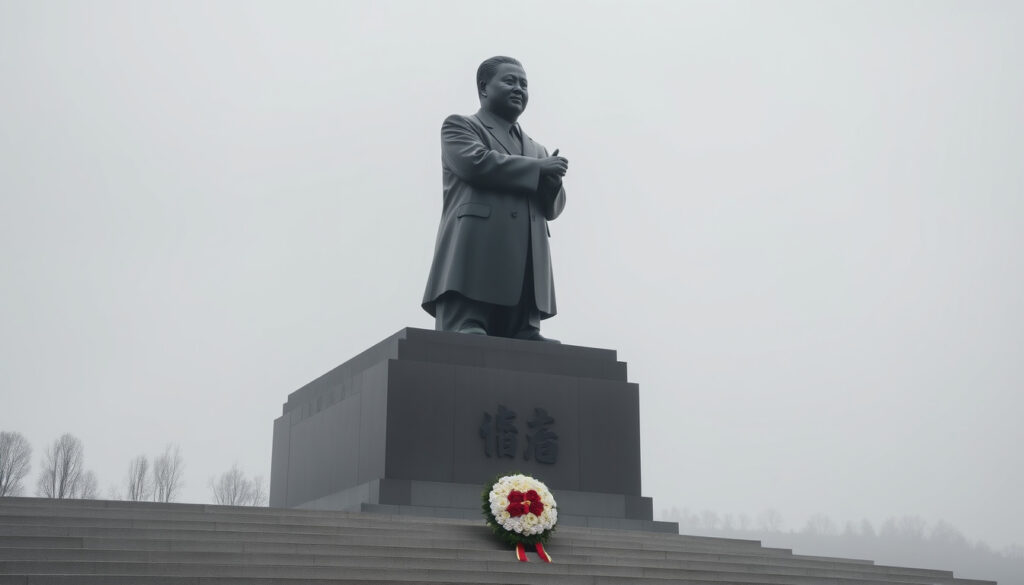
Kim Jong-Il: Death and Legacy of North Korea’s Dear Leader
For decades, the world watched North Korea through the carefully curated image of its second leader, a man known simply as the Dear Leader. When Kim Jong-Il died in December 2011, the official announcement came with a story of a heart attack on a train—but the real story was the succession plan that had been set in motion years earlier.
Born: 16 February 1941 or 1942 ·
Died: 17 December 2011 ·
Years as Supreme Leader: 1994–2011 ·
Official Title: Dear Leader ·
Cause of Death: Heart attack (official) ·
Father: Kim Il Sung
Quick snapshot
- Kim Jong-Il died on 17 December 2011 (38 North analysis)
- Official cause: heart attack (Brookings Institution analysis)
- He ruled from 1994 to 2011 (Wikipedia)
- Succeeded by his son Kim Jong-Un (Brookings Institution analysis)
- Exact year of birth (1941 or 1942) (Wikipedia)
- Exact circumstances of his death (Brookings Institution analysis)
- Number of wives and children (Wikipedia)
- 2008: Kim Jong-Il suffered a severe stroke (Brookings Institution analysis)
- September 2010: Kim Jong-Un promoted to four-star general (Brookings Institution analysis)
- 17 December 2011: Kim Jong-Il dies (38 North analysis)
- Kim Jong-Un inherits power at age 29 (Brookings Institution analysis)
- Workers’ Party formalizes succession (38 North analysis)
- Uncertainty for North Korea’s neighbors (Council on Foreign Relations analysis)
Here are the key facts about Kim Jong-Il’s life and rule.
| Attribute | Detail |
|---|---|
| Full Name | Kim Jong Il |
| Born | 16 February 1941 or 1942 |
| Died | 17 December 2011 |
| Title | Supreme Leader of North Korea |
| Years in Power | 1994–2011 |
| Father | Kim Il Sung |
| Son and Successor | Kim Jong Un |
| Official Cause of Death | Heart attack |
What happened to Kim Jong Il?
Official cause of death
- North Korean state media announced on 19 December 2011 that Kim Jong-Il had died two days earlier while traveling by train (38 North analysis).
- The official explanation cited a heart attack caused by “mental and physical overwork” (Brookings Institution analysis).
- Kim Jong-Il had been on a train tour of military and civilian sites at the time of his death (Brookings Institution analysis).
The pattern: a tightly controlled narrative that cast the leader’s death as a natural consequence of his dedication, while masking the regime’s vulnerability.
Circumstances of his death
- Kim Jong-Il had suffered a severe stroke in the summer of 2008, after which succession planning accelerated (Brookings Institution analysis).
- Analysts from 38 North noted that Kim Jong-Il himself had not finished the succession process before he died (38 North analysis).
- The death announcement was made in a tightly controlled media environment (The Washington Post video).
What this means: the official story of a heart attack may be true, but the real story is the regime’s scramble to present a seamless transition despite an incomplete succession plan.
Kim Jong-Il’s death on a train, while traveling to inspect sites, was a carefully staged final act of a leader who had long prepared his son for power—but not quite long enough.
How long did Kim Jong Il rule North Korea?
Start of his rule
- Kim Jong-Il became Supreme Leader in 1994 following the death of his father Kim Il Sung (Wikipedia).
- He was officially elected Chairman of the National Defense Commission in 1998 (Wikipedia).
Two key transitions, one pattern: formal titles followed years of behind-the-scenes consolidation.
End of his rule
- Kim Jong-Il ruled for 17 years, from 1994 until his death in 2011 (Brookings Institution analysis).
- His rule ended abruptly on 17 December 2011 (38 North analysis).
The implication: Kim Jong-Il’s reign was nearly two decades of unchallenged personal rule, but it ended before the final succession mechanism was fully in place.
What was Kim Jong Il famous for?
Cult of personality
- Kim Jong-Il was known for an institutionalized cult of personality that elevated him to near-divine status (Brookings Institution analysis).
- He was referred to as “Dear Leader” and was the subject of elaborate propaganda campaigns.
The paradox: the cult of personality was both a source of regime legitimacy and a vulnerability—when the leader dies, the cult must transfer instantly.
Nuclear program
- Kim Jong-Il oversaw North Korea’s nuclear weapons program, culminating in the first nuclear test in 2006 (Council on Foreign Relations analysis).
- He implemented the Songun (military-first) policy that prioritized the armed forces (Wikipedia).
Why this matters: the nuclear program became Kim Jong-Il’s legacy and a bargaining chip for his successor.
Economic policies
- Under Kim Jong-Il, North Korea experienced the “Arduous March” famine of the 1990s, which caused widespread suffering (Brookings Institution analysis).
- Economic hardship continued throughout his rule, with limited reforms.
The trade-off: Kim Jong-Il’s military-first policy left the economy in ruins, but it kept the regime in power.
The nuclear program Kim Jong-Il built was the foundation of North Korea’s international leverage. His son, Kim Jong-Un, has only expanded it.
What happened after Kim Jong Il died?
State funeral
- A state funeral was held for Kim Jong-Il in December 2011, with a tightly controlled media environment (The Washington Post video).
- The official obituary and state coverage immediately introduced Kim Jong-Un as the country’s next leader (38 North analysis).
The pattern: the funeral was as much a political event as a mourning ritual—it was the stage for the succession announcement.
Succession by Kim Jong Un
- Kim Jong-Un was publicly revealed as successor in September 2010, just over a year before his father’s death (Brookings Institution analysis).
- He was promoted to four-star general in September 2010 (Brookings Institution analysis).
- North Korean media described Kim Jong-Un as the “great successor” (38 North analysis).
- The Workers’ Party formalized Kim Jong-Un’s rise after Kim Jong-Il’s death (38 North analysis).
What this means: Kim Jong-Un inherited power at age 29 with a shorter consolidation period than his father had, but the party machinery was already in place to legitimize the transfer.
Was Kim Jong Il a good leader?
Economic record
- North Korea faced severe economic hardship and famine during Kim Jong-Il’s rule, particularly in the 1990s (Brookings Institution analysis).
- The “Arduous March” famine resulted in hundreds of thousands of deaths.
The catch: the regime survived, but at a devastating human cost.
Human rights record
- Human rights abuses were widespread under Kim Jong-Il, including political prison camps, forced labor, and suppression of dissent.
- South Korean intelligence later assessed that succession in the Kim family remained dynastic and hereditary (BBC News analysis).
Why this matters: the regime’s survival depended on control, not consent.
Nuclear program
- Kim Jong-Il advanced the nuclear program, conducting the first test in 2006 (Council on Foreign Relations analysis).
- This program became the core of North Korea’s foreign policy leverage.
The paradox: Kim Jong-Il’s legacy is a mixed one—economic failure and human misery, but a nuclear capability that his successors have only expanded.
Timeline of Kim Jong-Il’s life and rule
- – Kim Jong Il born (Wikipedia)
- – Becomes Supreme Leader after death of Kim Il Sung (Wikipedia)
- – Officially elected Chairman of the National Defense Commission (Wikipedia)
- – First nuclear test conducted (Council on Foreign Relations analysis)
- – Death of Kim Jong Il (38 North analysis)
- – Kim Jong Un succeeds as Supreme Leader (Brookings Institution analysis)
The timeline shows a rapid consolidation of power after the 2008 stroke, setting the stage for an incomplete succession.
Clarity and uncertainty
Confirmed facts
- Kim Jong Il died on 17 December 2011 (38 North analysis)
- He was the second Supreme Leader of North Korea (Wikipedia)
- He was succeeded by his son Kim Jong Un (Brookings Institution analysis)
- Official cause of death: heart attack (Brookings Institution analysis)
What’s unclear
- Exact year of birth (1941 or 1942) (Wikipedia)
- Exact circumstances of his death (Brookings Institution analysis)
- Number of wives and children
What remains unclear about Kim Jong-Il’s life and death continues to generate debate among analysts.
Quotes on Kim Jong-Il’s death and succession
“Our great leader Kim Jong-Il died of a heart attack caused by mental and physical overwork.”
– North Korean state media announcement, 19 December 2011 (Brookings Institution analysis)
“The revolutionary cause of Juche will be carried forward by the great successor Kim Jong-Un.”
– Kim Jong-Un, in his first public address after succession (38 North analysis)
“Kim Jong-il himself had not finished the succession process before he died.”
– 38 North analysis of the incomplete transition (38 North analysis)
“Kim Jong-il’s death has inspired uncertainty and anxiety about North Korea’s succession and the region.”
– Council on Foreign Relations assessment (Council on Foreign Relations analysis)
The death of Kim Jong-Il ended a 17-year rule that left North Korea with a nuclear program, a devastated economy, and a dynastic succession plan that was still incomplete. For Kim Jong-Un, the challenge was immediate: consolidate power in a system built for a single leader, while managing the expectations of a population that had known only the Kim family. The pattern of the Kim dynasty suggests that the transition was never meant to be smooth—it was meant to be controlled. For the international community, the question is whether the new leader will follow his father’s path of nuclear brinkmanship or chart a different course.
Related reading: Kim Jong-il to Kim Jong-un North Korea in transition · Kim Jong-il death cause of death rule succession
hrnkinsider.org, fpif.org, en.wikipedia.org, facebook.com, facebook.com
Frequently asked questions
What was Kim Jong Il’s official title?
He was the Supreme Leader of North Korea, often referred to as “Dear Leader.”
How did Kim Jong Il come to power?
He succeeded his father Kim Il Sung in 1994 after the elder Kim’s death.
What was the Songun policy?
The Songun (military-first) policy prioritized the military in national affairs and resource allocation.
Did Kim Jong Il have any siblings?
Yes, he had several siblings, including Kim Kyong-hui and Kim Pyong-il.
What was the Arduous March?
A period of severe famine and economic hardship in North Korea during the 1990s.
How did Kim Jong Il die?
Officially, he died of a heart attack while traveling by train on 17 December 2011.
Who succeeded Kim Jong Il?
His third son, Kim Jong Un, succeeded him as Supreme Leader.
More related posts
 What Is a Stye – Causes, Symptoms, Treatment Guide
 Gift Card Balance Checker: One4all, Primark & Visa
 Who Won the Liberal Leadership Race? Mark Carney Wins
 Gift Card Balance Checker: One4all, Primark, Visa Guide
 Carley Fortune Books in Order: The Complete Reading Guide
 Manulife Group Retirement Login: Step-by-Step Guide
 Michael Keaton: Biography, Facts, and Common Misconceptions
 Gilda Radner: Life, SNL, and Love with Gene Wilder
