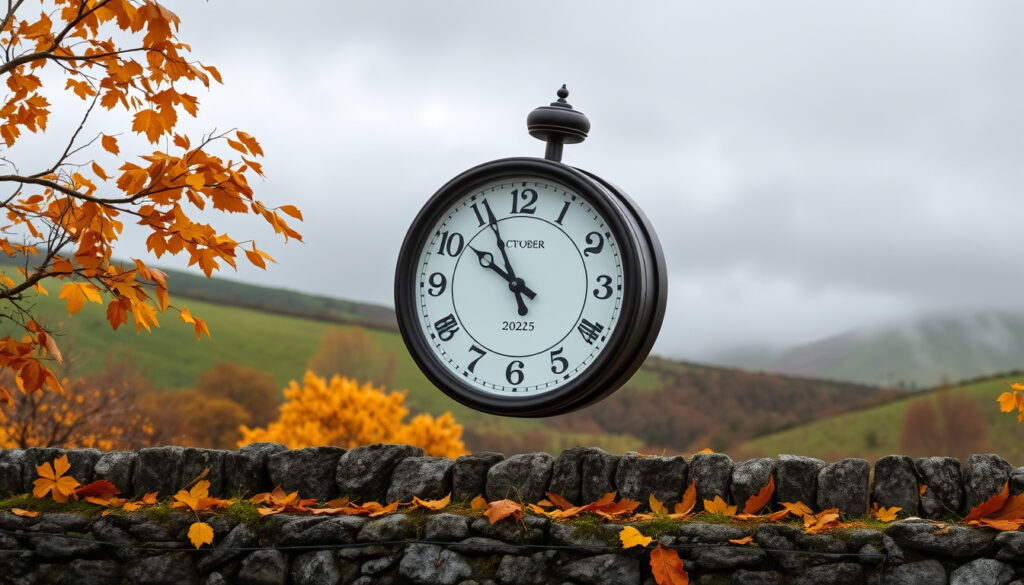
When Is the Time Change Fall 2025? Clocks Back Oct 26 Ireland
Evenings have been getting darker earlier — and there’s a concrete reason attached to a concrete date. On the last Sunday of October, Ireland joins the rest of the EU in turning clocks back one hour, trading the extra evening light of summer for an extra hour in bed. For anyone who’s ever wondered whether they’re gaining or losing sleep on that Sunday morning, the answer is straightforward.
Date: Sunday, 26 October 2025 · Time: 2:00 AM to 1:00 AM · Change: Clocks go back 1 hour · Location: Ireland · Effect: Extra hour gained
Quick snapshot
- 26 October 2025 at 2am (Wikipedia — Daylight Saving Time rules)
- Clocks go back 1 hour (Wikipedia — Daylight Saving Time rules)
- You gain an extra hour of sleep (Wikipedia — clock change mechanics)
- Sunrise comes earlier (Wikipedia — time offset effects)
- Evenings darken sooner (Wikipedia — seasonal light patterns)
- Irish Standard Time returns (Wikipedia — Irish Standard Time definition)
- Clocks spring forward in March 2026 (Wikipedia — spring transition rule)
- DST resumes for summer (Wikipedia — annual DST cycle)
Here’s a concise reference table capturing the essential parameters of this event.
| Field | Value |
|---|---|
| Event | End of Daylight Saving Time |
| Date | Sunday, 26 October 2025 |
| Time | 2:00 AM becomes 1:00 AM |
| Duration | 1 hour backward |
| Applies to | Ireland and EU |
When do the clocks change?
The clocks change on the last Sunday in October, which falls on 26 October 2025. This date isn’t arbitrary — it’s set by EU law that has governed the timing since 1996. The rule is consistent year to year: whatever the last Sunday of October happens to be, that’s when the change occurs.
Fall 2025 date in Ireland
Ireland follows the EU Summer Time Directive, which means the change happens simultaneously with every other EU country at 01:00 UTC. For Ireland, that translates to 2:00 AM Irish Summer Time turning back to 1:00 AM Irish Standard Time.
Exact time of change
The clock technically moves at the stroke of 2:00 AM. At that moment, clocks step back to 1:00 AM, meaning the 1:00–1:59 AM hour effectively repeats. If you have a digital alarm set for 1:30 AM, it will trigger twice — once at the original 1:30 AM and again after the reset.
Do the clocks go forward or back in October 2025?
They go back. This is the “fall back” portion of the familiar rhyme: spring forward, fall back. In spring, we advance clocks to squeeze more evening light into our schedules. In autumn, we reverse that — giving back an hour of morning daylight at the cost of earlier sunsets.
Fall back confirmation
The October change marks the official end of Daylight Saving Time for the year. Once the clocks revert, Ireland operates on Irish Standard Time (UTC+00:00), which sits at the same offset as Greenwich Mean Time. The pattern is straightforward and repeats annually.
Comparison to spring
In March, clocks spring forward from 1:00 AM to 2:00 AM, pushing the day forward by an hour. That extra evening light comes at the cost of a later sunrise. The October change simply reverses that adjustment, restoring standard time until the following March.
The implication is a seasonal seesaw: you trade evening light in autumn for morning light in winter, then reclaim evening light the following spring.
Do the clocks go back in October in Ireland?
Yes. Ireland is part of the EU’s coordinated DST schedule, so the change applies in full. Every EU country shifts at the same coordinated moment — 01:00 UTC — which keeps cross-border scheduling synchronized across the continent.
Ireland schedule
Ireland has no independent variation from EU rules. The change happens uniformly across the Republic, following the same last Sunday October rule as France, Germany, Spain, and every other EU member state.
EU alignment
The UK follows the same date (last Sunday in October) and the same time, but uses different terminology. While Ireland calls both its time offsets “Irish Standard Time,” the UK designates summer time as “British Summer Time” and winter as GMT. The practical effect on clocks is identical.
The catch is that despite Brexit, the UK and Ireland continue to share the same clock-change schedule, keeping cross-border activities in sync without formal coordination.
Do we lose or gain an hour in October?
You gain an hour. When clocks go back, the day has 25 hours instead of 24. That extra hour is yours — whether you spend it sleeping, working, or doing whatever you choose. The trade-off is that sunset arrives earlier, cutting into the after-work daylight window that summer provides.
Hour gained
At 2:00 AM on 26 October, clocks turn back to 1:00 AM. The hour between 1:00 and 2:00 AM happens twice — meaning if you were awake, you’d watch the clock run from 1:59 directly back to 1:00. For most people, the practical effect is waking up with an extra hour before their normal alarm.
Sleep impact
Sleep researchers note that the autumn change is generally easier to adjust to than the spring change. You don’t lose an hour of rest — you potentially gain one. However, the shift in light exposure can still affect sleep patterns for the first few days as your body recalibrates to earlier darkness.
What this means is that your internal clock faces a sudden shift in daylight cues, even though the calendar says you gained an hour.
Do we get an extra hour of sleep in October?
Practically speaking, yes. If you maintain your regular bedtime and wake time, you’ll have an extra hour of sleep that morning. The effect is most noticeable for anyone who normally sleeps through 1:00–2:00 AM — they’ll wake up having slept an hour longer than usual.
Bedtime benefits
The extra hour rewards night owls who typically stay up late. Someone who normally goes to bed at 11:00 PM and wakes at 6:00 AM will gain an hour of sleep simply by not adjusting their schedule. The clocks change, but your habits don’t need to.
Family prep tips
For families with children, the change is a natural opportunity to reset routines. Shifting bedtime 30 minutes earlier in the days leading up to the change can smooth the transition. Adults might use the extra hour for exercise, a leisurely breakfast, or simply hitting snooze.
Irish Standard Time aligns Ireland with GMT rather than continental Europe during winter. For anyone coordinating calls between Dublin and cities like Paris or Berlin, the one-hour difference becomes relevant after the October change. For more information, check out Emmagatzematge a prop meu a Irlanda.
Timeline of the change
The mechanics are straightforward, but the history behind the twice-yearly ritual stretches back over a century.
This historical sketch shows how a 19th-century idea became a global fixture by the 20th century.
| Date / Period | Event |
|---|---|
| 26 October 2025, 2:00 AM | Clocks turn back to 1:00 AM |
| March 2026 | Clocks spring forward (DST resumes) |
Historical context
DST was first proposed by George Hudson in New Zealand in 1895 and independently suggested by William Willett in Britain in 1907. The first practical implementation followed in Port Arthur and Fort William, Canada, on 1 May 1908. Germany and Austria-Hungary adopted nationwide DST on 30 April 1916 during World War I, marking the first large-scale use in Europe.
The UK and Ireland briefly trialed year-round summer time between 1968 and 1971, keeping clocks advanced permanently. The experiment ended, but the conversation about permanent DST has resurfaced periodically ever since. Russia abandoned permanent DST on 26 October 2014, returning to standard time year-round.
While DST exists to make better use of evening daylight, critics argue the twice-yearly disruption — worth roughly a week of adjustment per change — may outweigh benefits. The EU debated scrapping the changes entirely in 2018–2019, though no legislation was ultimately enacted.
The pattern shows that despite periodic efforts to end seasonal changes, the current EU framework has remained stable since 1996.
Clarity on what’s confirmed and what isn’t
Confirmed
- Date fixed as last Sunday October per EU rule since 1996
- Time set at 2am per EU Summer Time Directive
- Ireland’s winter offset is UTC+00:00 (Irish Standard Time)
What’s unclear
- Whether the EU will eventually abolish seasonal clock changes
- If post-Brexit UK will ever diverge from the EU schedule
What sources say
The clocks then ‘fall back’ an hour at 2am on the last Sunday of October (26 October, 2025).
— RTE (Irish national broadcaster)
The practice of advancing clocks to make better use of the longer daylight available during summer by having darkness fall at a later clock time.
— Wikipedia (Daylight Saving Time encyclopedia entry)
Summary
For Irish residents, the autumn clock change is straightforward: Sunday, 26 October 2025 at 2:00 AM, clocks go back one hour. You gain an hour of sleep, but lose evening daylight. The EU has followed this pattern since 1996, and Ireland’s alignment with that schedule remains solid. The main thing to watch in coming years is whether the EU follows through on earlier proposals to end seasonal changes entirely — for now, the twice-yearly ritual continues.
Related reading: CPP Payment Dates 2025 Ontario
Gain that extra hour of sleep when clocks fall back at 2:00 AM on October 26, as the Ireland 2025 clocks back guide details alongside practical prep tips.
Frequently asked questions
When do clocks change in Ireland?
Clocks change on the last Sunday in October. In 2025, that is 26 October, when clocks go back one hour at 2:00 AM.
Do the clocks go back on 26th October?
Yes. 26 October 2025 is the last Sunday in October, which is the designated date for ending Daylight Saving Time across the EU.
When do the clocks go back in 2026?
The 2026 autumn change falls on Sunday, 31 October 2026, following the same last Sunday in October rule.
Do we gain or lose an hour in October?
You gain an hour. Clocks go back, effectively extending the day to 25 hours and giving you an extra hour of sleep if you maintain your normal schedule.
What time do clocks change in fall 2025?
The change happens at 2:00 AM Irish Summer Time (01:00 UTC), when clocks revert to 1:00 AM Irish Standard Time.
Does Ireland follow EU time change rules?
Yes. Ireland follows the EU Summer Time Directive, which has set the change date as the last Sunday in October since 1996.
How does clock change affect sunrise?
After the change, sunrise occurs approximately one hour earlier by clock time. In late October, Dublin sees sunrise around 8:00–8:15 AM rather than 7:00–7:15 AM during summer time.
More related posts
 Citation Machine: Free APA, MLA, and Chicago Citation Generator
 Dave Chappelle: Biography, Net Worth, and Why He Walked Away
 Paul Stanley Kiss: Disability, Net Worth, and Family
 Stevie Wonder: Blindness, Jackson Connection, and Life Today
 Mira Nair: Biography, Films, Religion, Marriage & Net Worth
 Kylie Cantrall: Age, Relationship, and Disney Career
 Dumb and Dumber Cast – Guide to Stars, Roles and Highlights
