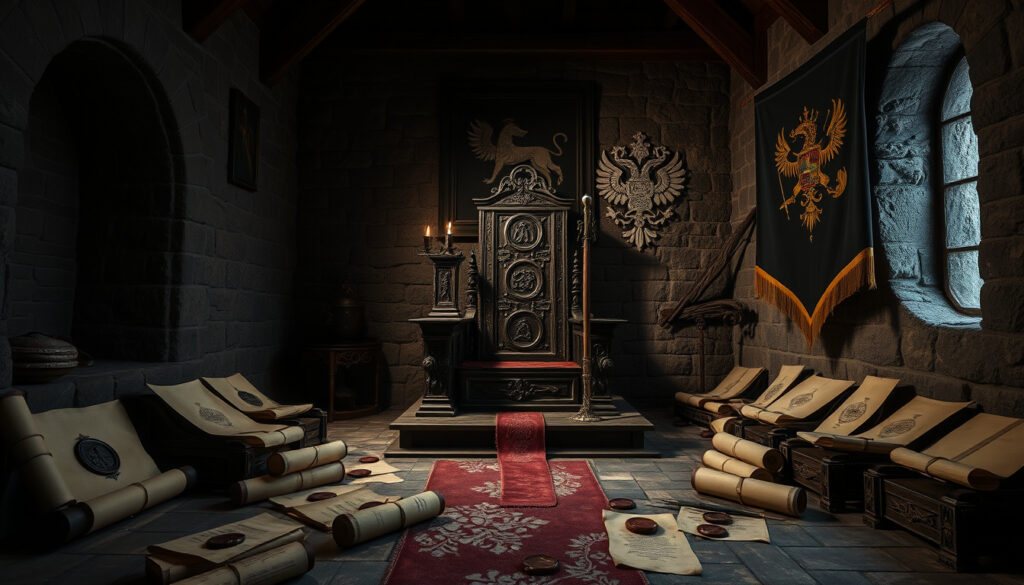
Ivan the Terrible: Tsar, Reforms, and the Oprichnina
Few rulers leave a legacy as contradictory as Ivan IV of Russia. He unified the state, expanded its borders, and then turned his own apparatus of terror against his people.
Born: 1530, near Moscow ·
Reign: 1533–1584 (51 years) ·
Title: First Tsar of all Russia (from 1547) ·
Known for: Centralization, Oprichnina terror, expansion into Siberia ·
Wives: At least 7 ·
Children who survived infancy: 3 (including Ivan Ivanovich, whom he killed)
Quick snapshot
- Ivan was the first crowned Tsar of Russia (Encyclopaedia Britannica)
- He established the Oprichnina in 1565 (Encyclopaedia Britannica)
- He conquered Kazan (1552) and Astrakhan (1556) (Encyclopaedia Britannica)
- He killed his eldest son Ivan in 1581 (New York Public Library)
- Whether he truly regretted killing his son (contemporary sources are mixed) (New York Public Library)
- Exact number of wives (some marriages were unrecognized by the Church) (Encyclopaedia Britannica)
- Whether his mental state was due to illness, trauma, or political strategy (Oxford Reference)
- Details of his death (possible poisoning, but not confirmed) (Encyclopaedia Britannica)
- 1530: Ivan born near Moscow (Encyclopaedia Britannica)
- 1565: Oprichnina established (Encyclopaedia Britannica)
- 1572: Oprichnina abolished (Encyclopaedia Britannica)
- 1584: Ivan dies (Encyclopaedia Britannica)
- Succession crisis after his death led to the Time of Troubles (Encyclopaedia Britannica)
- Ivan’s image remains a controversial symbol in modern Russian politics (After Russia)
- The Oprichnina model is referenced in debates about state violence (After Russia)
Six key facts about Ivan IV, drawn from the most authoritative sources available.
| Label | Value |
|---|---|
| Full name | Ivan Vasilyevich |
| Reign as Grand Prince | 1533–1547 |
| Reign as Tsar | 1547–1584 |
| Major wars | Livonian War (1558–1583), conquest of Kazan (1552), Astrakhan (1556) |
| Oprichnina period | 1565–1572 |
| Known children | Three surviving sons: Ivan (d. 1581), Fyodor (succeeded), Dmitry (d. 1591) |
Who was Ivan the Terrible and why was he called the “mad king”?
Ivan IV, born in 1530, became Grand Prince of Moscow at age three after the death of his father Vasily III. He was crowned the first Tsar of all Russia in 1547, a title that asserted autocratic authority over the boyar aristocracy. The epithet “Terrible” comes from the Russian grozny, meaning “formidable” or “awe-inspiring,” not necessarily cruel—though his later actions made the Western interpretation stick. His reign can be divided into two phases: the early reform period (1547–1560) and the later terror period marked by the Oprichnina.
Origins of the epithet “Terrible”
- The Russian word grozny implies power and fear, not moral condemnation. (Encyclopaedia Britannica)
- Ivan’s erratic behavior and brutal purges gave the nickname its modern weight. (After Russia)
- Contemporary chronicles describe him as both a pious reformer and a merciless ruler. (New York Public Library)
The implication: the same man who centralized the legal system and expanded the Russian state also created the Oprichnina, a state-within-a-state that terrorized the boyar class for seven years.
Did Ivan the Terrible regret killing his son?
Contemporary accounts of the 1581 incident describe Ivan striking his eldest son Ivan Ivanovich in a fit of rage during a personal argument. Histories are mixed on whether he later felt genuine remorse. Some chronicles report days of grief, while others question its sincerity. (New York Public Library)
How many wives did Ivan the Terrible have?
The Russian Orthodox Church recognized only three or four of Ivan’s marriages. He had at least seven known wives; the Church condemned the later unions as illegal. (Encyclopaedia Britannica)
Who were Ivan the Terrible’s parents?
Ivan’s father Vasily III died in 1533, leaving Ivan Grand Prince at age three. His mother Elena Glinskaya ruled as regent until her death in 1538, possibly poisoned. (Encyclopaedia Britannica)
Was Ivan the Terrible a good leader?
Historians are deeply divided. Ivan’s early reign brought genuine administrative and military reforms, but his later years were defined by paranoia, mass executions, and economic devastation. His legacy is a trade-off between state-building and state-sanctioned violence.
Pros: centralization, military expansion
- Ivan implemented a new legal code (Sudebnik of 1550) that standardized laws across Russia. (Oxford Reference)
- He reformed the military, creating a standing army and expanding into Kazan, Astrakhan, and Siberia. (Encyclopaedia Britannica)
- He established corporate-estate institutions in the 1550s, though he later dismantled them. (Oxford Reference)
Cons: terror, economic devastation
- The Oprichnina (1565–1572) involved mass confiscations of boyar lands and public executions. (Encyclopaedia Britannica)
- The policy shattered Russia’s political, economic, and social life. (New York Public Library)
- Ivan personally killed his eldest son in 1581, triggering a succession crisis. (New York Public Library)
The consequence: Ivan’s dual legacy left Russia stronger in territory but weaker in governance.
What did Ivan the Terrible do to reshape Russia?
Ivan’s most transformative and destructive policy was the Oprichnina, a separate domain under his direct control that he used to break the power of the boyar aristocracy. The Oprichnina was enacted in 1565 and lasted until 1572.
The Oprichnina
- The Oprichnina was a separate political and territorial domain, dividing Russian lands into two parts: the tsar’s domain and the remaining lands under traditional administration. (Encyclopaedia Britannica)
- It included about twenty towns and various individual buildings. (University of North Carolina Greensboro)
- Ivan raised a bodyguard force of oprichniki, numbering from about 1,000 to 6,000 men. (Encyclopaedia Britannica)
- The Oprichnina was associated with confiscation of boyar lands and the removal of nobles from their estates. (Encyclopaedia Britannica)
Military reforms
- Ivan reformed the army, creating a professional core that enabled the conquest of Kazan (1552) and Astrakhan (1556). (Encyclopaedia Britannica)
- The Livonian War (1558–1583) drained resources and ultimately failed, contributing to the economic strain that fueled the Oprichnina. (Encyclopaedia Britannica)
Ivan’s reforms built the institutional foundation of autocratic Russia, but the Oprichnina destroyed the very elites who could have stabilized the state. The result was a hollowed-out central power that crumbled after his death.
The pattern: Ivan’s centralization efforts ultimately undermined the state’s resilience.
How did Ivan’s reforms lead to centralization?
Ivan’s early reforms in the 1550s are widely seen as a prelude to later autocratic centralization. Oxford Reference notes that he helped establish corporate-estate institutions but later judged them unacceptable limits on autocratic authority. (Oxford Reference)
Legal and administrative changes
- The Sudebnik of 1550 standardized legal procedures and reduced the power of provincial governors. (Encyclopaedia Britannica)
- Ivan established the zemsky sobor (assembly of the land) to legitimize his rule, but later sidelined it. (Encyclopaedia Britannica)
- The Oprichnina divided the state into two parallel administrations, with the tsar’s domain exempt from traditional laws. (Encyclopaedia Britannica)
The pattern: Ivan’s desire for unchecked power led him to destroy the very institutions he had built, creating a vacuum that no successor could fill.
Comparison: Ivan’s reforms vs. Oprichnina terror
Six aspects of Ivan’s rule, one pattern: the same ruler who modernized Russia also inflicted its worst internal violence before the 20th century.
| Aspect | Reforms (1550s) | Oprichnina (1565–1572) |
|---|---|---|
| Legal system | Unified law code (Sudebnik) | Arbitrary arrests and executions |
| Military | Professional standing army | Oprichniki as private terror force |
| Land ownership | Promoted service gentry | Confiscated boyar estates |
| Taxation | Reformed tax collection | Extortion and tribute |
| Territorial expansion | Conquered Kazan, Astrakhan, Siberia | Lost Crimean Tatar raid (1571) |
| Succession | Planned dynastic continuity | Killed his own son; chaos after death |
The trade-off: Ivan’s early achievements laid the groundwork for the Russian Empire, but his later terror left the state bankrupt, depopulated, and leaderless.
Timeline: Key events in Ivan’s reign
- 1530 – Ivan born near Moscow. (Encyclopaedia Britannica)
- 1533 – Father Vasily III dies; Ivan becomes Grand Prince at age 3. (Encyclopaedia Britannica)
- 1547 – Crowned first Tsar of all Russia. (Encyclopaedia Britannica)
- 1550s – Reforms: new law code, military reorganization. (Oxford Reference)
- 1552 – Conquest of Kazan. (Encyclopaedia Britannica)
- 1556 – Conquest of Astrakhan. (Encyclopaedia Britannica)
- 1565 – Establishes Oprichnina – reign of terror begins. (Encyclopaedia Britannica)
- 1571 – Crimean Tatars burn Moscow; Oprichnina fails to defend the capital. (Encyclopaedia Britannica)
- 1572 – Oprichnina abolished. (Encyclopaedia Britannica)
- 1581 – Ivan kills his son Ivan Ivanovich. (New York Public Library)
- 1584 – Ivan the Terrible dies, possibly from poisoning. (Encyclopaedia Britannica)
The Oprichnina’s seven-year arc shows how a ruler’s paranoia can turn state institutions into instruments of repression. For modern Russia, the precedent is a cautionary tale about unchecked executive power.
The implication: Ivan’s paranoia ultimately doomed his own regime.
Confirmed facts vs. unresolved questions
Confirmed facts
- Ivan was the first crowned Tsar of Russia (Encyclopaedia Britannica)
- He killed his eldest son Ivan in 1581 (New York Public Library)
- He established the Oprichnina (1565–1572) (Encyclopaedia Britannica)
- He conquered Kazan and Astrakhan (Encyclopaedia Britannica)
- He ruled for 51 years (Encyclopaedia Britannica)
What’s unclear
- Whether he truly regretted killing his son (contemporary accounts are mixed) (New York Public Library)
- Exact number of wives (some marriages were unrecognized by the Church) (Encyclopaedia Britannica)
- Whether his mental state was due to illness, trauma, or political strategy (Oxford Reference)
- Details of his death (possible poisoning, but not confirmed) (Encyclopaedia Britannica)
- Whether he killed his son on purpose (contemporary accounts differ) (New York Public Library)
The pattern: the balance of certainty tilts toward established facts, but key questions about Ivan’s motivations and death remain open.
Quotes on Ivan’s dual legacy
“Ivan’s reign was a paradox of reform and terror. He built the institutions of a modern state while simultaneously destroying the social fabric that held it together.”
Historian Robert O. Crummey, from his work on Ivan IV
“The Oprichnina was not an irrational outburst but a calculated political strategy to centralize power by eliminating the boyar opposition.”
Modern historian Isabel de Madariaga, offering a revisionist view
“Contemporary chronicles describe the 1581 incident as a moment of uncontrollable rage, followed by days of grief. Whether the grief was genuine remains debated.”
Primary chronicle sources, via the New York Public Library exhibition
For the Russian state, the choice is clear: Ivan’s legacy is a warning that the tools of centralization, when wielded without restraint, can consume the very power they are meant to preserve. The Oprichnina ended in 1572, but its shadow falls on every subsequent debate about state violence and autocracy.
en.wikipedia.org, rbth.com, encyclopedia.com, en.wikipedia.org, simple.wikipedia.org, globalsecurity.org, muse.jhu.edu
For a closer look at his reforms and the enduring debate around his legacy, An article on Australia Current offers a comprehensive overview.
Frequently asked questions
What does “Terrible” mean in the context of Ivan IV?
The Russian word grozny means “formidable” or “awe-inspiring,” not necessarily cruel. The English translation “Terrible” reflects the fear he inspired later in his reign. (Encyclopaedia Britannica)
Did Ivan the Terrible kill his son on purpose?
Contemporary accounts say Ivan struck his son Ivan Ivanovich in a fit of rage during a personal argument. There is no evidence of premeditation. (New York Public Library)
How many wives did Ivan the Terrible have according to the Church?
The Russian Orthodox Church recognized only three or four of his marriages. He had at least seven known wives, but the Church condemned the later ones as illegal. (Encyclopaedia Britannica)
Was Ivan the Terrible a good military leader?
He was successful in expanding Russia eastward (Kazan, Astrakhan, Siberia) but failed in the Livonian War against the West, which exhausted his treasury. (Encyclopaedia Britannica)
What ended the Oprichnina?
The Oprichnina was abolished in 1572 after the Oprichniki failed to defend Moscow against a Crimean Tatar attack. Ivan had to merge the two administrations back. (Encyclopaedia Britannica)
How did Ivan the Terrible die?
Ivan died in 1584 at age 54. Some sources suggest poisoning, but the exact cause remains unconfirmed. (Encyclopaedia Britannica)
What is Ivan the Terrible’s legacy in Russia today?
Ivan remains a controversial figure. Some nationalists praise him for unifying Russia, while others condemn his tyranny. The Oprichnina is often cited in debates about state violence. (After Russia)
Did Ivan the Terrible only rule with terror?
No. His early reign (1547–1560) was marked by genuine reforms, including a new law code and military modernization. The terror phase began with the Oprichnina in 1565. (Oxford Reference)
The takeaway: Ivan’s rule cannot be reduced to terror alone; his early reforms were substantial.
More related posts
 Michele Lamy: Beliefs, Age, and the High Priestess of Paris
 Perchance AI Guide: Free Generators, Chat, and Safety
 Tom Cochrane: Life Is a Highway, Wife, Age & Tourette’s Rumors
 Century Gardens Recreation Centre: Gym, Pool, Prices & Reviews
 Smith Metal Works LT: Custom Railings & Fabrication in GTA
 The Falls Hotel and Inn: Clifton Hill Reviews & Photos
 Emraan Hashmi: Son’s Cancer, Religion & Alia Bhatt
 Benfica vs FC Barcelona Lineups – Predicted XIs and Team News
