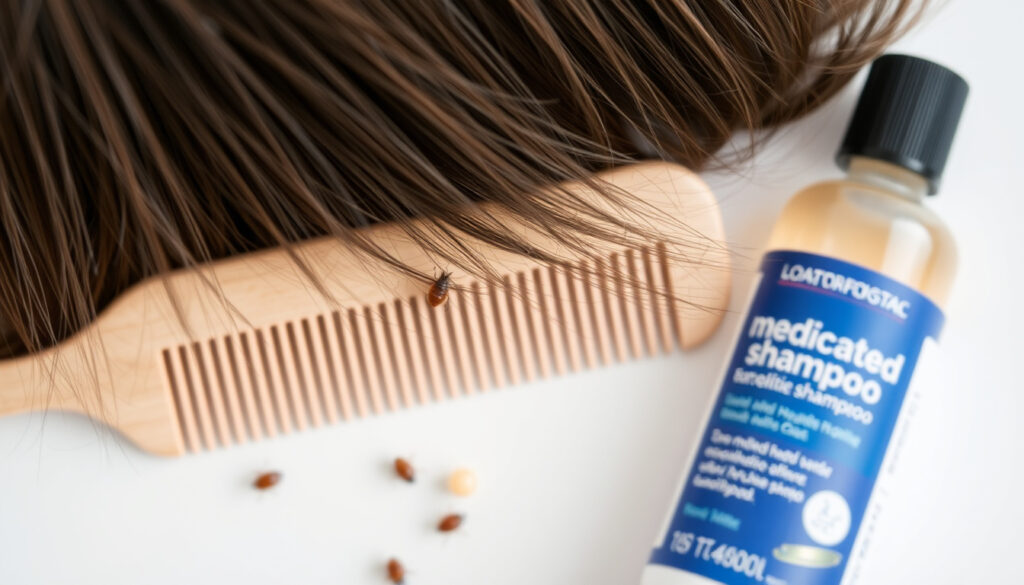
Lice Eggs: Identification, Treatment, and Prevention Tips
Anyone who’s ever found tiny white specks in their child’s hair knows the sinking feeling. But not all specks are the same — and mistaking dandruff for lice eggs can lead to unnecessary treatments. This guide walks you through evidence-based identification, treatment, and prevention, with clear distinctions between viable eggs and empty casings drawn from public health authorities.
Eggs per day per female louse: 6 · Hatching time: 7-10 days · Survival off scalp: 24-48 hours · Heat kill threshold: 130°F (54°C) · US cases in children yearly: 6-12 million
Quick snapshot
- Yellow/brown before hatching, white after — Helsenorge
- Tiny (0.8mm), oval shape (Helsenorge)
- Glued to hair shaft near scalp — CDPH
- Over-the-counter permethrin/pyrethrin — Nottinghamshire NHS
- Prescription ivermectin/malathion — Mayo Clinic
- Wet combing every 2 days for 2 weeks — Helsenorge
- Pillows: eggs die within 48 hours — CDC
- Pets: cannot spread human lice — CDC
- Dandruff: flakes flake off, nits stick — Helsenorge
Six key facts about lice eggs, all verified by health authorities:
| Attribute | Value |
|---|---|
| Egg shape | Oval, like a sesame seed — Helsenorge |
| Egg color before hatching | Yellow, tan, or brown — Helsenorge |
| Egg color after hatching | White or clear (nit) — Helsenorge |
| Attachment strength | Cemented to hair, does not flake off — CDPH |
| Location on hair shaft | Within 1/4 inch (6mm) of scalp — Mayo Clinic |
| Hatching time | 7-10 days from laying — CDC |
What Do Lice Eggs Look Like and Can You See Them?
What color are lice eggs?
- Viable eggs are yellow, tan, or brown — not white. White casings are empty nits left after hatching, according to Helsenorge (Norwegian public health portal).
- Each egg is tiny — about 0.8 mm, roughly the size of a sesame seed — and oval-shaped.
Lice eggs vs dandruff: how to tell the difference
The key difference is attachment. California Department of Public Health (CDPH) states that dandruff can be brushed away easily, but lice eggs are firmly glued to the hair shaft. Leicestershire Partnership NHS Trust (UK National Health Service) confirms that nits are often confused with dandruff.
Six characteristic differences, one pattern:
| Feature | Lice eggs | Dandruff |
|---|---|---|
| Appearance | Oval, uniform, translucent | Irregular flakes |
| Attachment | Stuck to hair shaft | Falls off easily |
| Location | Within 6mm of scalp | Anywhere on scalp |
| Removal | Needs nit comb or fingernail | Rubs off |
| Color (live) | Yellow/tan/brown | White |
| Color (dead) | White/clear | White |
If you can flick it off with a fingernail, it’s dandruff. If it stays put, it’s likely a nit — but that doesn’t mean live lice are present.
What do empty nit casings look like?
After hatching, the empty egg case remains attached to the hair. Nottinghamshire Healthcare NHS Foundation Trust (NHS trust) notes that nits can survive as empty cases for months. They appear white or clear and are often found farther from the scalp than viable eggs.
The implication: finding only white, distant nits suggests a past infection, not an active one.
What Kills Lice Eggs Fast and Instantly?
Over-the-counter and prescription treatments
- Permethrin and pyrethrin are common OTC options. Nottinghamshire Healthcare NHS Foundation Trust recommends a second application 7 days later to kill newly hatched lice.
- Prescription options include ivermectin and malathion, available through a healthcare provider.
- Mayo Clinic (nonprofit medical center) notes that suffocation-based treatments like dimethicone and benzyl alcohol are also available.
Home remedies: what works and what doesn’t
Heat is the only home method with solid evidence. CDC (U.S. public health agency) confirms that temperatures above 130°F (54°C) kill lice eggs in minutes. That’s why machine washing bedding in hot water and high-heat drying works.
No home remedy — olive oil, mayonnaise, vinegar — has been proven to kill eggs instantly in all cases. A review article (PMC) notes that evidence for essential oils is limited.
Many OTC products kill live lice but not eggs. That’s why fine-comb removal is essential, and why a second treatment is needed one week later.
The pattern: no single product kills both live lice and all eggs in one pass — combing is non-negotiable.
How to use a nit comb effectively
Wye Valley NHS Trust (UK health service) advises wet combing with a fine-toothed nit comb. Gouvernement du Québec (public health authority) recommends dividing hair into thin sections and combing from scalp outward, focusing behind ears and nape.
Why this matters: consistent combing every 2-3 days for two weeks can break the cycle without chemicals.
Why Do I Keep Finding Lice Eggs But No Lice?
Active infestation vs old nits
Mayo Clinic explains that live nits are attached within 6mm of the scalp. Eggs farther away are likely dead or empty. Helsenorge warns that finding eggs close to the scalp suggests infestation but does not prove live lice — eggs may already be hatched or dead.
How far from the scalp are lice eggs?
Females lay eggs at the base of the hair shaft. As hair grows, eggs move outward. An egg more than 1/4 inch from the scalp is either hatched or non-viable. North Dakota Health and Human Services suggests using a hand lens or microscope to confirm identification.
When to consider a past infection
If you only see white nits farther than 6mm from the scalp, and no live lice after thorough checking, you likely have a resolved infestation. Leicestershire Partnership NHS Trust states that treatment is needed only when active infestation is present.
The pattern: empty nits ≠ live lice. Don’t treat based on nits alone.
How Long Do Lice Eggs Live and Can They Survive on Pillows?
Survival off the human scalp
Lice eggs depend on the warmth and humidity of the scalp. CDC reports that nits die within 24-48 hours at room temperature away from the host.
Can lice eggs live in pillows?
Yes, but not for long. Eggs on pillows or bedding lose viability quickly. Helsenorge advises washing towels and combs at 60°C (140°F) or freezing for at least 4 hours to kill lice and eggs.
Best practices for cleaning bedding
- Machine wash in hot water (130°F / 54°C) and dry on high heat.
- Items that cannot be washed can be sealed in a plastic bag for 2 weeks.
- CDC confirms that pets do not spread human lice.
What this means: laundering bedding is important, but the scalp is the real battleground.
How to Prevent Lice Eggs from Hatching
Regular head checks
CDPH recommends combing hair every 2 to 3 days for two weeks or until no nits are found. Helsenorge recommends daily or every-other-day combing for 12-14 days.
Using leave-in repellent products
No strong evidence supports repellent sprays or essential oils for preventing infestation. The PMC review notes lack of proof for most commercial repellents.
Avoid sharing personal items
Hats, brushes, headphones, and scarves can transfer lice. CDC advises avoiding head-to-head contact and not sharing these items.
The trade-off: vigilance with combing and hygiene is more reliable than any spray.
Upsides
- Wet combing is chemical-free and effective when done consistently.
- Heat treatment (laundry, hot water) kills eggs without chemicals.
- OTC treatments are widely available and affordable.
Downsides
- Most OTC products do not kill eggs; two applications needed.
- Home remedies (vinegar, mayonnaise) lack proven efficacy.
- Empty nits remain attached for months, causing confusion.
Step-by-Step: How to Check for and Remove Lice Eggs
- Wet hair and apply conditioner to make combing easier.
- Section hair into small parts and use a fine-toothed nit comb from scalp outward.
- Focus on behind the ears and nape of the neck — CDC says these are hotspots.
- Wipe comb on a paper towel and inspect for eggs and lice.
- Repeat every 2-3 days for at least 2 weeks to catch newly hatched lice.
- Wash combs and towels in hot water (60°C) or freeze for 4 hours.
For parents, the choice is clear: consistent combing plus targeted treatment is the only proven way to eliminate both lice and eggs. Relying on a single product or home remedy will likely leave eggs behind.
What the Evidence Says
Confirmed facts
- Lice eggs are glued to hair shafts and cannot be easily removed (Helsenorge).
- Heat above 130°F kills lice eggs (CDC).
- Female lice lay 6 eggs per day (CDC).
- Eggs off the scalp die within 24-48 hours (CDC).
What’s unclear
- Whether suffocation-based products (dimethicone) are more effective than pesticide treatments.
- Efficacy of essential oil repellents on active infestation.
- Direct evidence of egg survival time on different pillow materials.
Expert Perspectives
“Head lice checks should focus behind the ears and at the nape of the neck, where crawling lice and nits are commonly found.”
CDC (U.S. public health agency)
“Live nits are typically attached very close to the scalp, while nits farther than about 6 mm from the scalp are likely dead or empty.”
Mayo Clinic (nonprofit medical center)
“Nits are the eggs or egg cases of head lice and can be confused with dandruff.”
Leicestershire Partnership NHS Trust (UK National Health Service)
“Dandruff is easier to brush away than lice eggs, which cling firmly to the hair shaft.”
Helsenorge (Norwegian public health portal)
For parents and caregivers, the implication is clear: distinguishing live eggs from empty nits is the key to avoiding unnecessary treatment. The evidence shows that consistent combing, heat laundry, and targeted product use — not home remedies — are the most reliable path to eradication.
For a comprehensive overview, refer to this guide for identifying and treating lice eggs that covers both identification and effective removal methods.
Frequently asked questions
Can lice eggs hatch after treatment?
Yes, if the treatment did not kill all eggs. That’s why a second application 7-10 days later is recommended to kill newly hatched lice.
Are lice eggs contagious?
Lice are contagious through direct head-to-head contact. Eggs themselves are not easily transferred, but if a viable egg falls off and hatches, it can start a new infestation.
How many lice eggs are usually found in one infestation?
Female lice lay about 6 eggs per day, so a typical infestation can have dozens to hundreds of eggs over time.
Can you scratch lice eggs out of your hair?
No, the eggs are cemented to the hair shaft. Scratching may remove occasional loose nits, but systematic combing is needed.
Do lice eggs need oxygen to survive?
Yes, but they have a specialized structure (operculum) that allows gas exchange. Suffocation-based products block this exchange.
Does vinegar kill lice eggs?
No. Vinegar is sometimes used to loosen nit glue, but it does not kill eggs. You still need to comb them out.
Can you see lice eggs with the naked eye?
Yes, they are visible as tiny specks, about the size of a sesame seed. A magnifying glass or strong light helps.
How long after treatment are lice eggs still visible?
Empty nits can remain attached for months. Their presence does not indicate active infestation.
More related posts
 Billy Beane: Moneyball Legacy, Career, and Where He Is Now
 Kate Jackson: Illness, Feuds, and Life After Charlie’s Angels
 Dodi Fayed: Biography, Diana, and Cause of Death
 Patrik Laine: Career, Personal Life & Video Game Habit
 Robert Kardashian: Attorney, Trial, and Family Legacy
 Chappell Roan Good Luck, Babe!: Meaning, Charts & Impact
 Jessie Buckley: Family, Oscar Win & Key Facts
 John Krasinski: Biography, Career, Net Worth & Family
