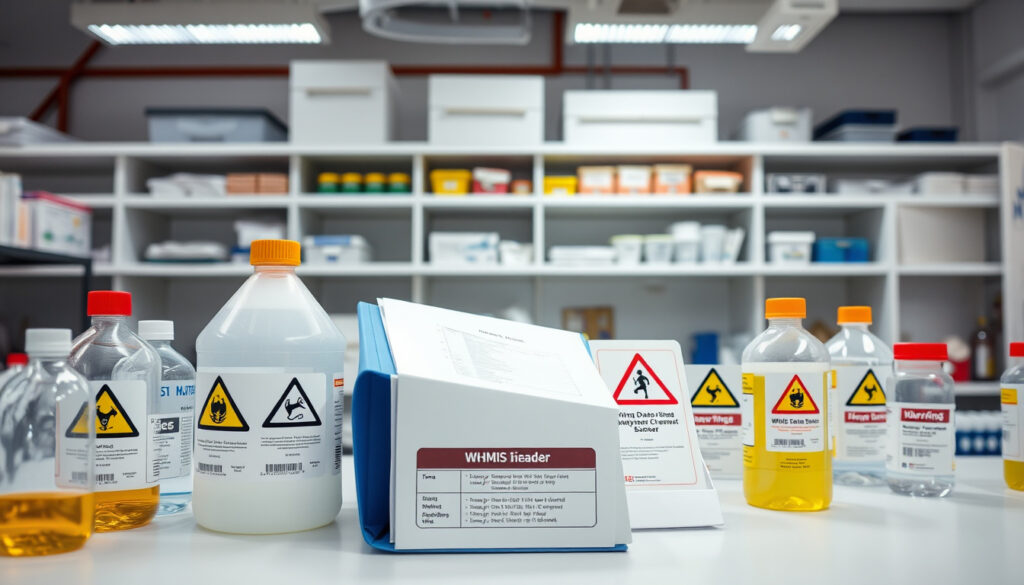
What Does WHMIS Stand For? | Full Guide to Canada’s Hazard Law
If you’ve ever worked in a Canadian lab, factory, or warehouse, you’ve probably seen those diamond-shaped labels with symbols like a flame or a skull. They’re part of a system that’s been mandatory since 1988: WHMIS, which stands for the Workplace Hazardous Materials Information System — Canada’s national hazard communication standard, and understanding it isn’t optional; it’s the law under the Hazardous Products Act.
WHMIS stands for: Workplace Hazardous Materials Information System ·
WHMIS became law in Canada in: 1988 ·
WHMIS aligns with GHS: since 2015
Quick snapshot
- Canada’s national hazard communication system for workplace chemicals (Health Canada, federal regulator)
- Requires labels, safety data sheets, and worker education (CCOHS, national occupational health centre)
- Aligns with GHS since 2015 (CCOHS)
- All Canadian employers who handle or store hazardous materials (eSafetyFirst, workplace safety training)
- Workers exposed to hazardous products (WorkSafeNB, provincial regulator)
- Suppliers of hazardous materials (eSafetyFirst YouTube, training provider)
- WHMIS is law under the Hazardous Products Act and Controlled Products Regulations (Safety Evolution, health and safety advisory)
- Enforced by federal and provincial/territorial agencies (eSafetyFirst)
- Penalties for non‑compliance include fines and imprisonment (Safety Evolution)
- Hazard classification and product labelling (Health Canada)
- Safety data sheets (SDS) (CCOHS)
- Worker education and training (Canada Safety Training, compliance provider)
Six key facts about WHMIS, one pattern: the system is both federal and provincial — a coordinated two‑tier framework.
| Fact | Detail |
|---|---|
| Full Name | Workplace Hazardous Materials Information System |
| Year Enacted | 1988 |
| GHS Alignment | 2015 |
| Jurisdiction | Canada (federal and provincial/territorial) |
| Main Purposes | Identify hazards, communicate risks, protect worker health and safety |
| Applies to | Hazardous products used in Canadian workplaces |
What does WHMIS stand for?
WHMIS full name and acronym meaning
- WHMIS stands for Workplace Hazardous Materials Information System (Health Canada, federal regulator).
- It is Canada’s national hazard communication standard (CCOHS, national occupational health centre).
- The acronym is pronounced “WHIM‑iss” and is used in all provincial workplace safety regulations.
The “H” stands for “hazardous,” not “harmful” — the system covers any material that could pose a risk in a workplace, from cleaning solvents to laboratory reagents.
Who operates WHMIS in Canada
- The federal government (Health Canada) sets supplier obligations: classification, labels, SDS (eSafetyFirst YouTube, training provider).
- Provincial and territorial bodies (e.g., WorkSafeNB, Ontario Ministry of Labour) enforce employer and worker requirements (WorkSafeNB, provincial regulator).
- This split means a supplier label must meet federal rules, while a workplace label must also satisfy local legislation.
The implication: WHMIS is not a single agency — it’s a coordinated layer cake of federal principles and provincial enforcement.
What are the three components of WHMIS?
Labels and their role
- Supplier labels: provided by manufacturers and importers, must include product identifier, hazard pictograms, signal words, hazard statements, precautionary statements, and supplier identifier (Health Canada).
- Workplace labels: required when a product is decanted or a supplier label is missing or illegible; must contain product name, safe handling information, and a reference to the SDS.
Safety data sheets (SDS)
- SDS provide detailed hazard information in a 16‑section format (CCOHS).
- Employers must ensure SDS are available for every hazardous product in the workplace (Canada Safety Training, compliance provider).
Worker education and training
- Two‑part training: general education (rights and responsibilities) and site‑specific training (actual products in use) (Canada Safety Training).
- Training is mandatory for all workers exposed to hazardous products, including paid, unpaid, and student interns (Canada Safety Training).
- There is no fixed expiry date, but training must be refreshed when new hazards are introduced or conditions change (Canada Safety Training).
Employers must pay for all training time and costs — including for unpaid interns — and can face enforcement action if training is not documented.
The pattern: WHMIS is built on a closed loop of information — supplier → label/SDS → employer → worker — and each link is legally enforceable.
Is WHMIS only in Canada?
WHMIS and GHS alignment
- WHMIS is specific to Canada, but since 2015 it has aligned with the Globally Harmonized System (GHS) of classification and labelling (CCOHS).
- This alignment means hazard classes, pictograms, and SDS formats are compatible across GHS‑adopting countries.
Other countries with similar systems
- The United States uses the Hazard Communication Standard (HazCom), also aligned with GHS but not identical to WHMIS.
- Many other nations (EU member states, Australia, Japan) have adopted GHS directly or with local adaptations.
- WHMIS remains uniquely Canadian in its specific product coverage, label language requirements, and enforcement split.
Why this matters: Canadian employers importing chemicals must ensure both WHMIS and GHS compliance, but the label and SDS must meet Canadian legal specifications.
What are the 5 main hazard categories in WHMIS?
Physical hazards classification
- WHMIS divides hazards into two main groups: physical and health (CCOHS).
- Physical hazards include flammable liquids, gases under pressure, explosives, oxidizing substances, and corrosive to metals.
Health hazards classification
- Health hazards cover acute toxicity, skin corrosion/irritation, serious eye damage, respiratory sensitization, germ cell mutagenicity, carcinogenicity, reproductive toxicity, and target organ toxicity.
Environmental hazards classification
- Environmental hazards (e.g., aquatic toxicity) are recognized but not included in the WHMIS hazard group — they are regulated separately under the Canadian Environmental Protection Act.
The catch: Many people think there are “5 main categories,” but the official system has two broad groups with dozens of specific hazard classes underneath. The number “5” often refers to the most common pictograms or the five physical hazard classes under GHS, but it’s not a WHMIS‑defined set.
What are the categories 1, 2, 3, and 4 for flammable liquids?
According to CCOHS, WHMIS follows GHS criteria which define four flammable liquid categories based on flash point and initial boiling point:
| Category | Flash point | Initial boiling point | Example |
|---|---|---|---|
| 1 | < 23 °C | ≤ 35 °C | Gasoline |
| 2 | < 23 °C | > 35 °C | Acetone |
| 3 | ≥ 23 °C and ≤ 60 °C | — | Diesel fuel |
| 4 | > 60 °C and ≤ 93 °C | — | Engine oil |
The trade‑off: Category 1 liquids are the most dangerous — a spark can ignite them at very low temperatures. Category 4 still requires handling precautions but is far less volatile.
Which 3 products are excluded under WHMIS?
Prescription and over‑the‑counter drugs
- Drugs regulated by the Food and Drugs Act are excluded from WHMIS labelling, though the workplace version of the same chemical may still be covered.
Food and food additives
- Food products and additives intended for consumption are regulated by the Canadian Food Inspection Agency, not WHMIS.
Cosmetics and consumer products
- Cosmetics fall under the Canada Consumer Product Safety Act; consumer products in retail packaging are exempt from WHMIS even if they contain hazardous ingredients.
Additional exemptions include pesticides (governed by the Pest Control Products Act), explosives, and radioactive materials (Safety Evolution).
Why this matters: A product that is “consumer grade” (e.g., a household bleach) is exempt from WHMIS, but the same chemical in bulk industrial packaging is fully covered.
Is WHMIS the law?
- Yes — WHMIS is mandated by the federal Hazardous Products Act and the Controlled Products Regulations, plus provincial/territorial occupational health and safety acts (Safety Evolution).
- In Ontario, Regulation 860 (WHMIS) specifically requires compliance (WSPS, workplace safety provider).
- Penalties for non‑compliance can include fines (up to $500,000 or more depending on jurisdiction) and imprisonment.
The implication: WHMIS is not a voluntary guideline — it’s a legal framework with teeth.
Confirmed facts
- WHMIS stands for Workplace Hazardous Materials Information System (Health Canada)
- WHMIS has been law in Canada since 1988 (Safety Evolution)
- Three core components: labels, safety data sheets, worker education (CCOHS)
What’s unclear
- The exact number of chemical products covered is not officially published; estimates vary widely
- The exact relationship between hazard categories across different provincial interpretations may not be identical — some provinces add local requirements on top of federal rules
- Whether a formal WHMIS “certificate” is required is often misunderstood — the law mandates training but does not prescribe a specific certificate format (Canada Safety Training)
- Aligned with GHS since 2015, but the exact alignment details can vary by province
- Flammable liquid categories 1–4 based on flash point and boiling point are well-defined, but provincial enforcement may add nuanced handling requirements
- Excludes drugs, food, cosmetics, consumer products, but the boundary between consumer and industrial packaging can be ambiguous in practice
“WHMIS is a comprehensive system for providing health and safety information on hazardous products intended for use, handling, or storage in Canadian workplaces.”
CCOHS (national occupational health centre)
“Canada describes WHMIS as the country’s hazard communication standard.”
Health Canada (federal regulator)
“WHMIS has been Canadian law since 1988 and is enforced through the Hazardous Products Act and provincial or territorial regulations.”
Safety Evolution (health and safety advisory)
For Canadian employers handling hazardous materials, WHMIS compliance is not a box‑ticking exercise — it’s a legal duty that protects workers and avoids penalties. The choice is clear: invest in proper training and labelling, or face enforcement action that can reach six‑figure fines and even jail time.
For a more detailed breakdown of the system’s components and pictograms, refer to this comprehensive guide to WHMIS.
Frequently asked questions
What does GHS stand for in WHMIS?
GHS stands for Globally Harmonized System of Classification and Labelling of Chemicals. It is the international framework that WHMIS has aligned with since 2015.
How often must WHMIS training be renewed?
There is no fixed national expiry date. Training must be updated when new hazards are introduced, work conditions change, or if a worker needs a refresher. Employers determine frequency based on risk.
What is a safety data sheet?
A safety data sheet (SDS) is a 16‑section document that provides detailed information about a hazardous product, including its composition, hazards, safe handling, and emergency measures.
What are WHMIS symbols called?
They are called hazard pictograms. WHMIS 2015 uses 10 pictograms, such as the flame for flammables and the skull and crossbones for acute toxicity.
Who enforces WHMIS in Ontario?
The Ontario Ministry of Labour, Immigration, Training and Skills Development enforces WHMIS Regulation 860 under the Occupational Health and Safety Act.
Can WHMIS labels be in English only?
Federal regulations require labels in both English and French for products sold across Canada. In practice, most supplier labels are bilingual. Workplace labels may be in one official language depending on provincial rules.
Are pesticides covered under WHMIS?
No — pesticides are regulated under the Pest Control Products Act and are exempt from WHMIS (though they may still carry hazard symbols).
What happens if an employer does not follow WHMIS?
Penalties can include fines up to $500,000 or more, imprisonment, and stop‑work orders. Compliance is enforced by provincial inspectors and federal agencies.
More related posts
 Dumb and Dumber Cast – Guide to Stars, Roles and Highlights
 Corb Lund Biography: Real Name, Songs, and Personal Life
 When Is the Time Change Fall 2025? Clocks Go Back Oct 26 Ireland
 Craig Berube: Nationality, Injury, Firing, and Biography
 Chris Kyle: The True Story of the American Sniper
 Chicago Fire Season 14 – Premiere Date, Cast and Episodes
 Kyler Murray: Height, Contract, Injury & Latest News
 100°F to °C: Exact Conversion & Common Misconceptions
